We’re building Hyperbolic around a simple goal: make the world’s GPU compute unified, productive, and liquid. Today, we’re taking a big step toward it.
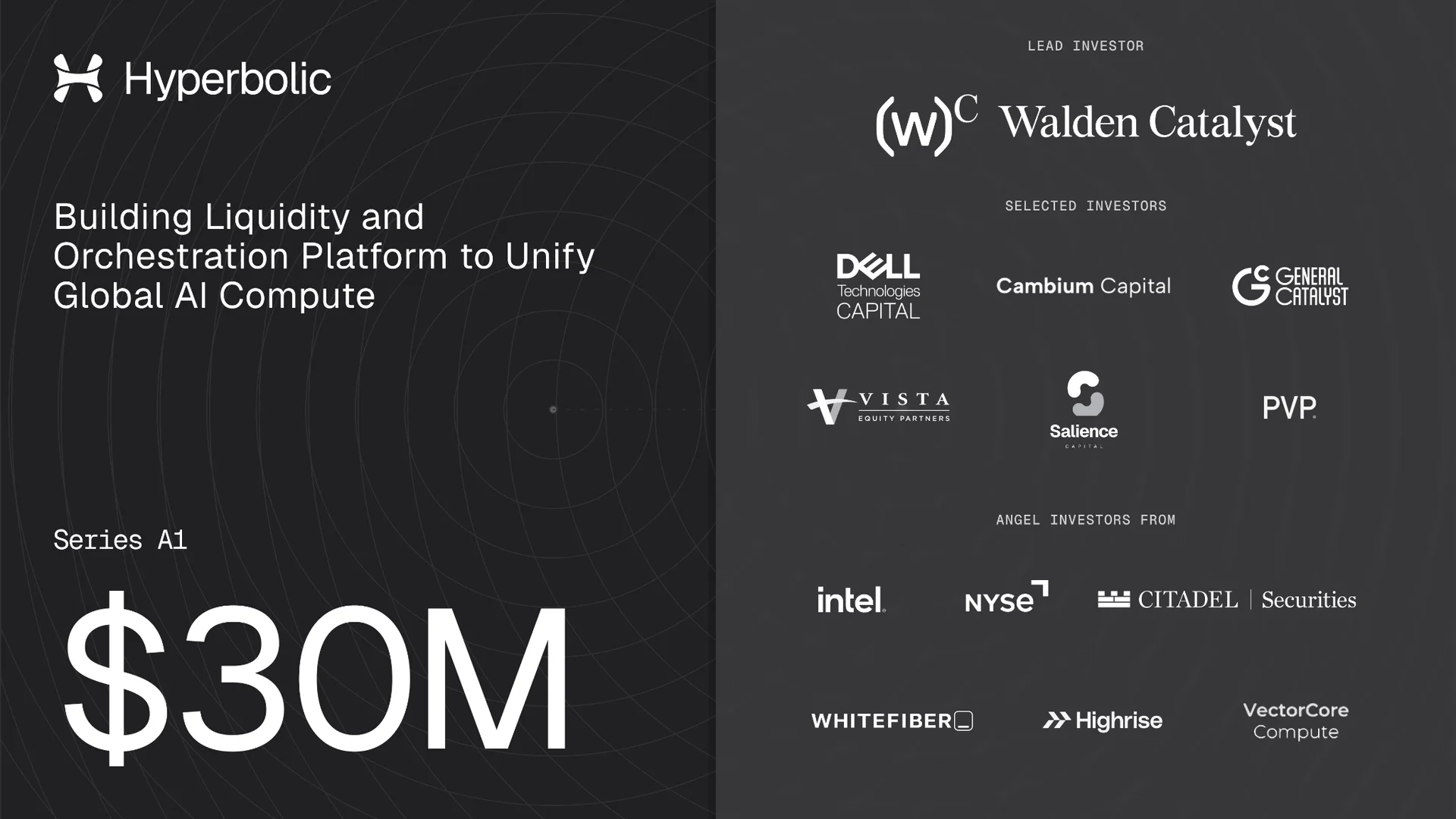
We’re announcing $30 million in Series A1 funding led by Walden Catalyst, the venture capital firm founded by Intel CEO Lip-Bu Tan and former Samsung Electronics Corporate President and CSO Young Sohn. The round also included Dell Technologies Capital, General Catalyst, Vista Equity Partners, Cambium Capital, Salience Capital, and other strategic investors. This funding will advance Forge, our unified control plane, expand our multi-cloud orchestration solutions and value-added services, and develop the first Global Compute Grid.

We’re also incredibly grateful for the support of our angel investors, including Lip-Bu Tan, CEO of Intel; Robert F. Smith, David A. Breach, Monti Saroya, and Justin Hirsch from Vista Equity Partners; Fang Wu, Wenjun Qiu, Lin Chen, and Xiangyi Huang from Citadel Securities; Ravi Namboori from Vector Core Compute; Hughes Ching, co-founder of WhiteFiber; and Sridhar Masam, CTO of NYSE.
Their experience spans semiconductors, financial markets, and cloud infrastructure, and we’re excited to have them supporting us as we build Hyperbolic.
"The demand for AI compute will continue to grow, but adding more hardware is only part of the answer. The value of that investment depends on how effectively the capacity is put to work and made available to the teams that need it. We believe Jasper and his team are addressing a fundamental challenge in the AI stack, and we’re excited to support them as they build that platform."
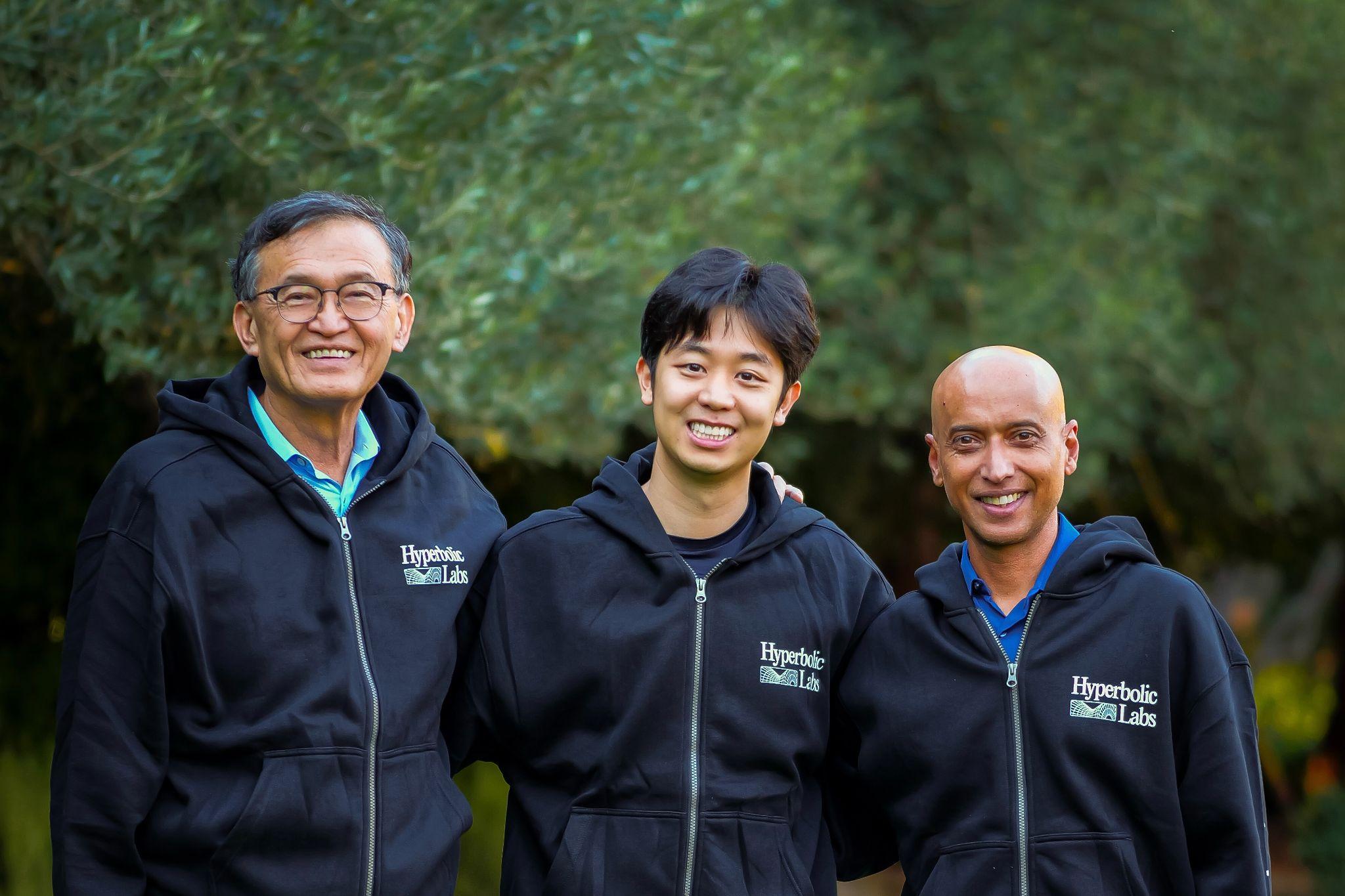
From left to right: Lip-Bu Tan (Founding Managing Partner at Walden Catalyst, CEO of Intel), Jasper Zhang (Founder and CEO of Hyperbolic), and Shankar Chandran (Partner at Walden Catalyst).
Making fragmented compute work together
AI teams need reliable capacity that matches their workloads and budgets. Yet today’s GPU cloud ecosystem spans more than 300 providers with different hardware, networking, software, and operational standards. Teams face complex procurement, rigid contracts, and engineering overhead, often paying for capacity that sits idle between workloads. GPU providers, meanwhile, need to turn their investments in hardware, power, and data centers into productive capacity and consistent revenue.
Our approach draws on our founder and CEO Jasper Zhang’s background in mathematics and quantitative research. After completing his PhD at UC Berkeley in two years, he worked on market making at Citadel Securities. Those experiences shape how we approach the problem today. Our broader team brings experience from Google Cloud, Lambda, Lightning AI, VMware, Supermicro, Citadel, and Point72.
"AI Compute is deeply challenged by supply and demand mismatch, making it incredibly difficult to harness for the AI developer. Moreover, the myriad of options on compute, interconnects, storage, memory, as well as heterogeneity in the software stack compounds the challenge of accessing available capacity. Hyperbolic’s innovative AI Stack has solved this massive complexity and has aggregated AI compute capacity across compute providers, providing AI developers with simple, transparent, and reliable access to AI compute."
Forge, our unified control plane, standardizes heterogeneous bare-metal GPU clusters into validated infrastructure, with a common dashboard for provisioning, virtualization, networking, and operations across providers. Our managed Kubernetes and inference services help teams run AI workloads, and through a unified API, teams can access models hosted by Hyperbolic and external providers.
The goal is straightforward: more useful work per GPU hour and lower effective compute costs for AI teams, while helping GPU providers bring capacity to market faster, increase utilization, and maximize yields on their infrastructure.
"AI teams should be able to access compute wherever it is, run their workloads, and turn unused capacity into revenue through one platform. We’re bringing orchestration and liquidity together so customers have more flexibility in how they use compute, while providers get more productive use and better returns from their infrastructure."
Leading AI teams build on Hyperbolic
More than 250,000 AI builders use Hyperbolic, including teams at Modal, Higgsfield, Daytona, HeyGen, Voio, RadixArk, and Pika. Here’s what some of them have to say.
Higgsfield needed H100 capacity quickly for production inference, then moved to a reserved contract as demand stabilized:
"After adding additional models to the platform, we needed H100 capacity quickly for production inference. Hyperbolic was able to get us the capacity fast, on demand, gradually building up to the total volume we needed. Once things stabilized, they converted us to a reserved contract at a rate that was 35% cheaper than on-demand and 20% cheaper than anything else we were seeing in the market."
RadixArk scaled its GPU resources on Hyperbolic as its requirements evolved:
"Hyperbolic consistently delivered the capacity, flexibility, and responsiveness we needed. The quality of their GPU infrastructure and their ability to rapidly scale GPU resources as our requirements evolved allowed us to stay focused on building great products. Beyond the technology, their team was highly responsive and acted as a true partner, helping us navigate growth without worrying about capacity constraints."
Daytona runs GPU sandboxes for its customers and uses Hyperbolic’s API to bring new capacity online as demand grows:
"As demand for Daytona’s GPU sandboxes grows, we need compute capacity that can grow with us. Hyperbolic makes it easy to access GPUs, even on short notice. We use their API in our operations, and their responsive team helps us get new capacity up and running so we can scale the compute available to our customers."
What we’re building next
This round gives us the resources to expand the software and services that make distributed GPU capacity work as one platform.
We’re expanding our multi-cloud orchestration solutions to provision compute and orchestrate workloads, including inference, across providers based on cost, performance, and availability. Alongside our managed Kubernetes and inference services, we plan to add support for Slurm, automated scaling, and unified data services.
We’re also building the first Global Compute Grid, where suppliers and customers can buy, sell, and resell eligible GPU capacity. The vision is for compute to work like electricity: draw capacity as needed, scale up or down, and sell eligible unused capacity back to the grid. Planned spot instances, dynamic pricing, and market-making strategies will help match supply with demand, and we’re exploring ways to help customers and suppliers hedge compute price risk.
Over time, we want customers to bring a model, a workload, or even an idea, along with their deadline and budget, and have Hyperbolic automatically provision the compute and continuously optimize how it runs. That same programmable infrastructure could let AI agents acquire capacity within defined budgets and policies, and make AI accelerators and their revenue streams easier to value and finance.
"We believe AI agents will become the largest consumers of compute. They’re not going to wine and dine with 20 different neocloud sales or sign contracts lasting three years or more. They need a programmable way to discover compute, acquire capacity, and run workloads. We’re building Hyperbolic as one unified platform that handles the infrastructure and orchestration for them. By making compute easier to access, use, and trade, we’re also laying the foundation for AI infrastructure to become an investable asset class."
Thank you to our customers, infrastructure partners, investors, and team for building with us. We’re focused on making global GPU compute simpler to use and more productive at scale.
Building AI or bringing GPU capacity to market? Explore Hyperbolic at https://app.hyperbolic.ai/


